Do New Libraries Help Children Read?
This project started on Dolly Day, 25 September 2026, the day that celebrates Dolly Parton's Imagination Library and its free books for young children. The question it raised was simple: does having books nearby actually change how children read?
The question
When a public library opens near a school, do the children there become better readers? And does it matter how you measure "near": as a straight line on a map, or as the minutes it takes to walk there?
The approach
I built a national record of every US public library opening, closure and move from 2008 to 2024 from the federal Public Libraries Survey. The survey's own coordinates turned out to be unusable for tracking moves, so every address was re-located. Then I checked all 528 openings near a school by hand against library websites and local news. About a third were not real openings (long-existing libraries newly added to the survey, or temporary sites during renovations). Reading scores for almost every US school district came from the Stanford Education Data Archive.
Each district that gained a library was compared with districts in the same state that had no library change nearby, tracking how scores changed in the years before and after. To avoid picking the analysis that gave the nicest answer, the main test was written down and registered publicly before a single real result was calculated, and the method was first proven on fake data to find a known effect and nothing where there was none. Walking, cycling and driving times from about 42,000 schools to nearby libraries were routed on OpenStreetMap road networks across the country.
The result
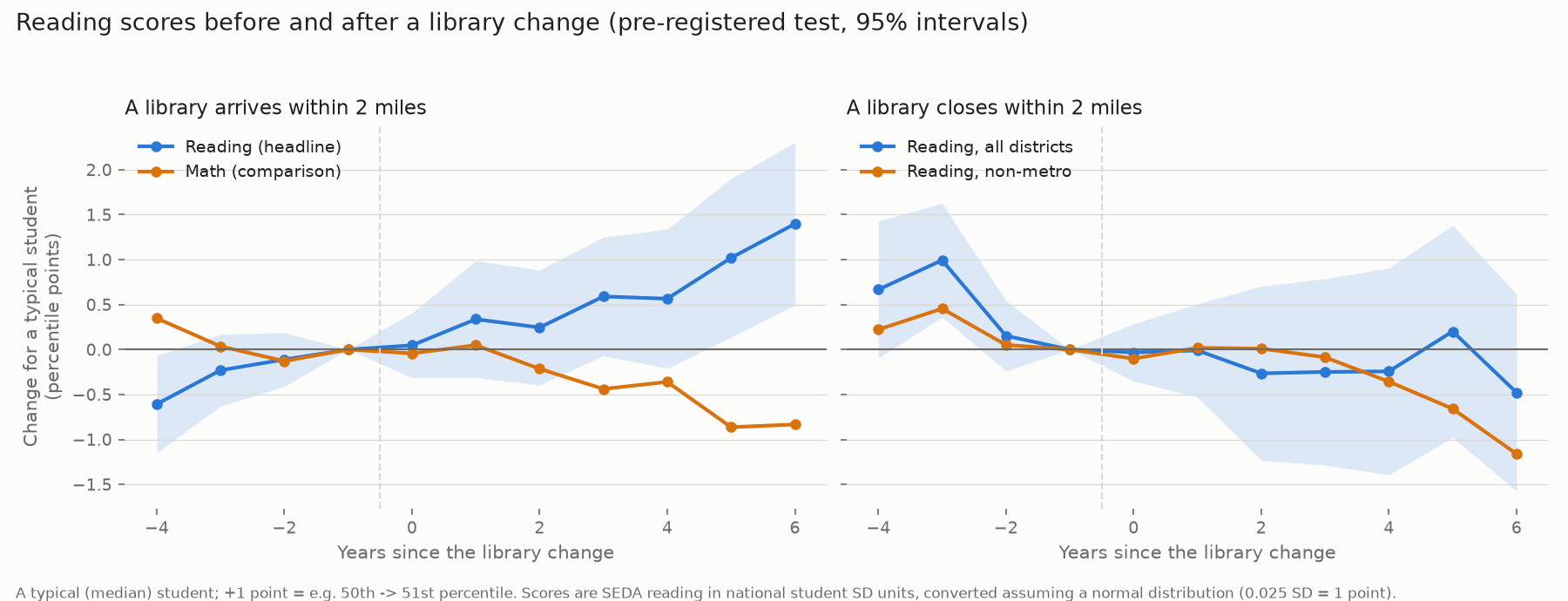
The registered test came out positive but small: reading scores rose by about half a percentile point on average over the seven years after an opening, building slowly to about 1.4 points by year six. Math did not move. The effect was larger where the opening was confirmed by hand. Districts that got new libraries were already improving slightly beforehand, and when each one was compared only with districts growing at a similar pace, that earlier drift disappeared while the reading gain remained. Children's program attendance in library systems that opened a branch rose about 13%, over the same slow timescale.
Then the sharpest test: if being near a library is what helps, districts where a new library saved families the most walking or driving time should gain the most. They don't. The gain appears where the new library barely changed travel times, and in districts where most families own cars; places that gained their first walkable library show no gain.
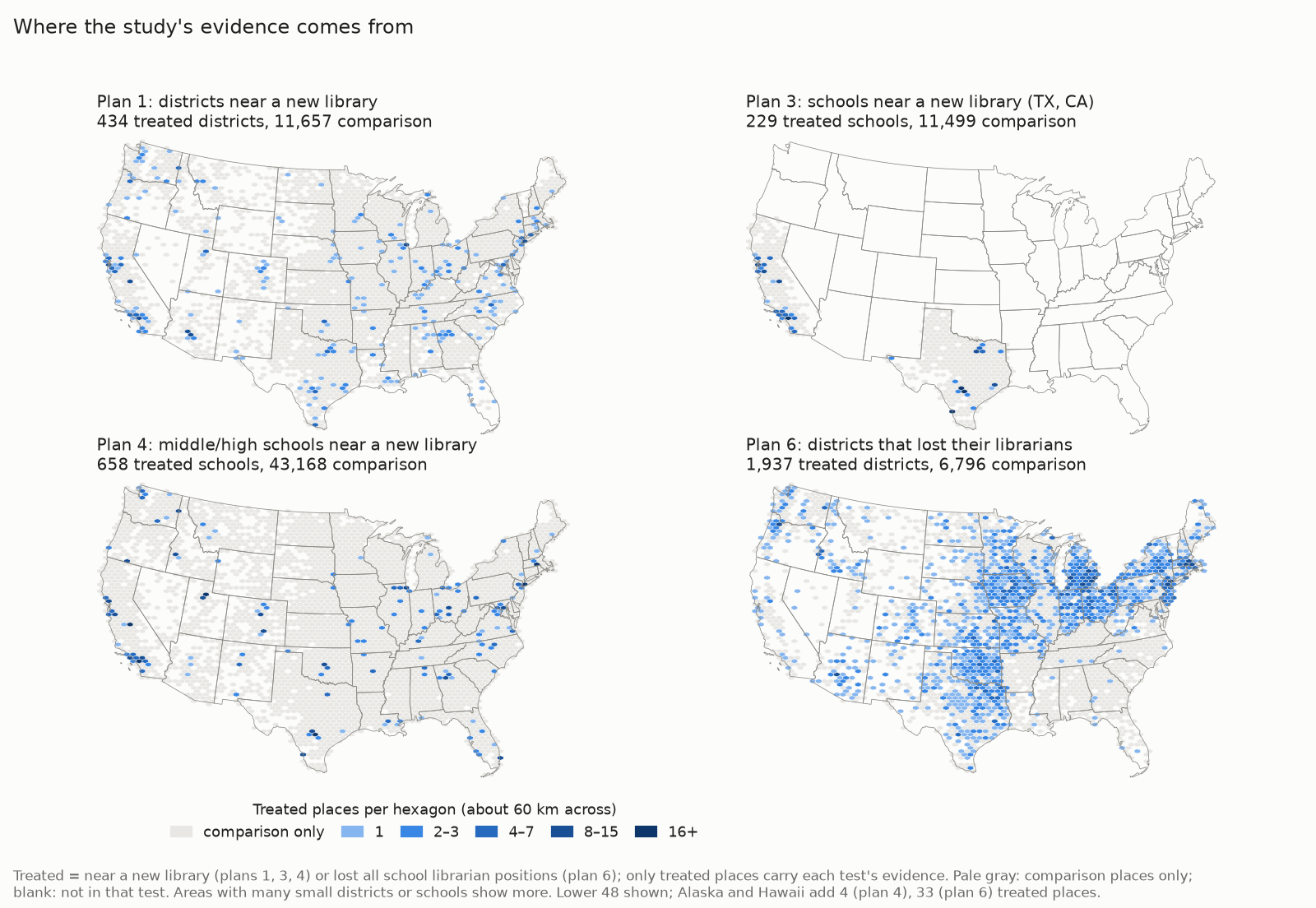
District averages blur things, though: a new branch sits next to only a few of a district's schools. So I registered a second test before looking, using the two states with the most schools near new libraries and complete school-by-year test results, Texas and California. It compared the 235 schools within a mile of a new library with other schools in their own district.
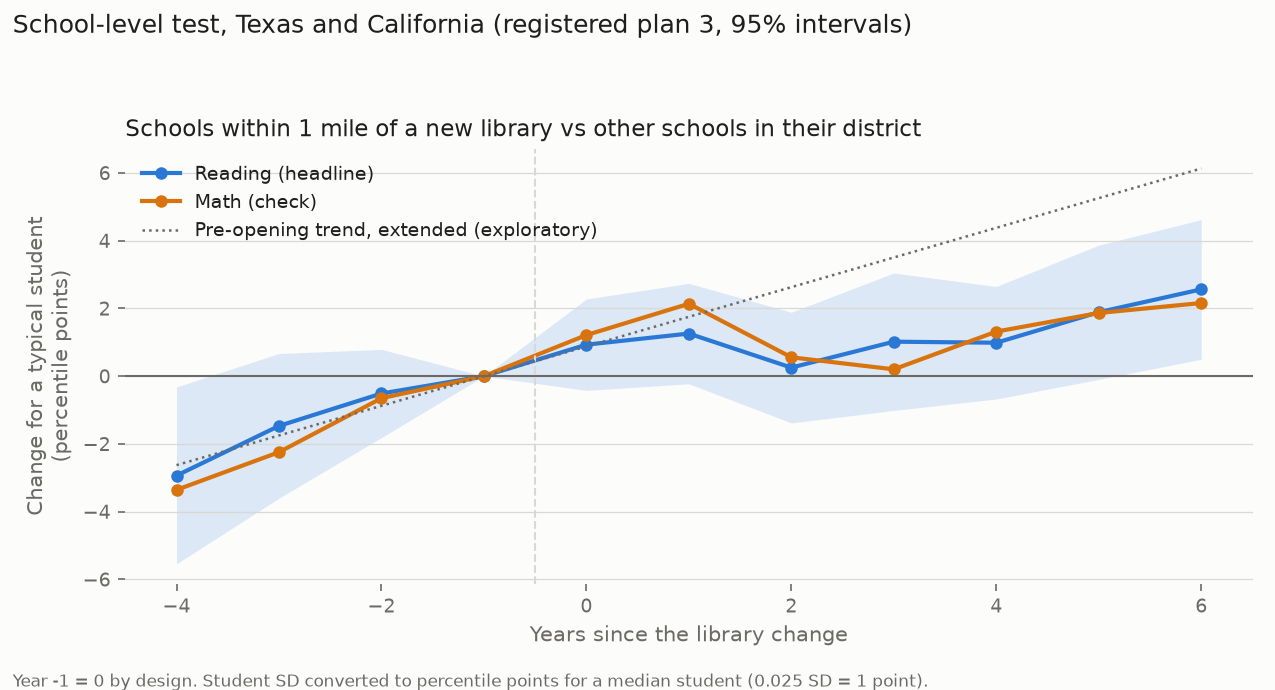
Those schools did do a little better after the opening: about 1.3 percentile points, twice the district figure, though the result just misses statistical certainty. But the pattern doesn't look like the library at work. The gain didn't grow with the walking minutes each school saved. Math rose just as much as reading. And these schools were already improving, relative to their district, in the years before the library opened.
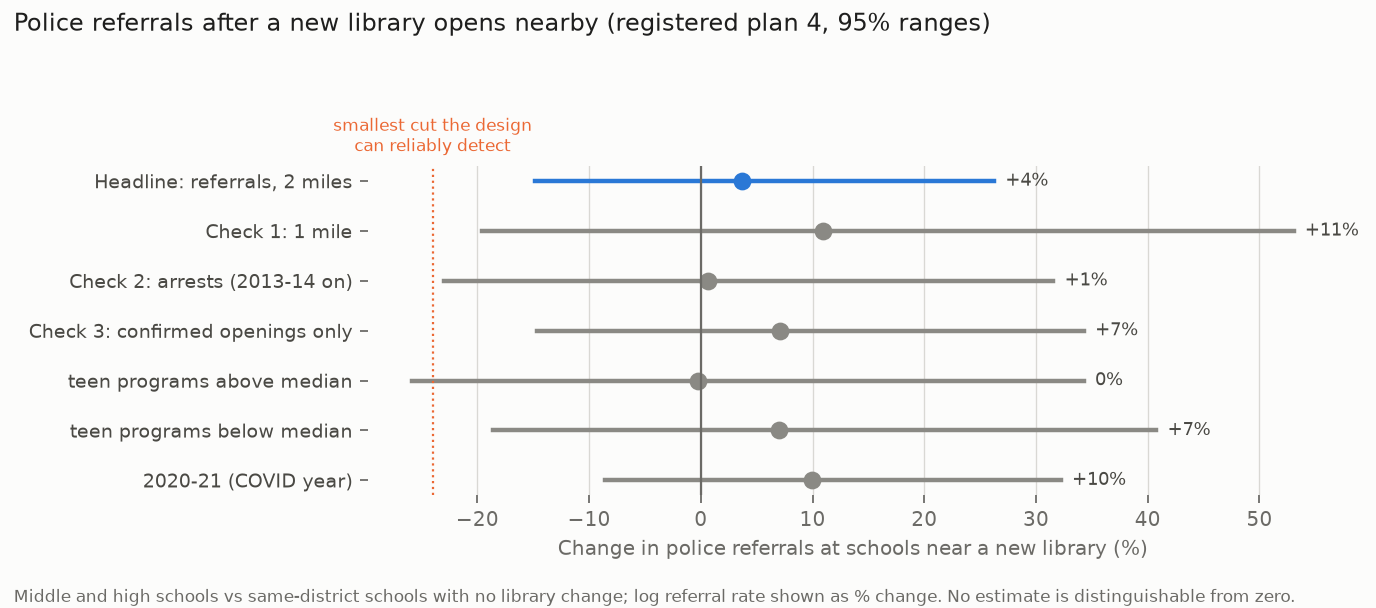
A third registered test asked about something else a library might offer: a safe place for teenagers after school. If that mattered, middle and high schools near a new library might send fewer students to the police. They don't. Referrals to law enforcement at the 672 schools within 2 miles of a new library changed by about +4% relative to other schools in their district, with a range from about 15% fewer to 26% more. That rules out any big drop. Arrests and teen programs told the same story.
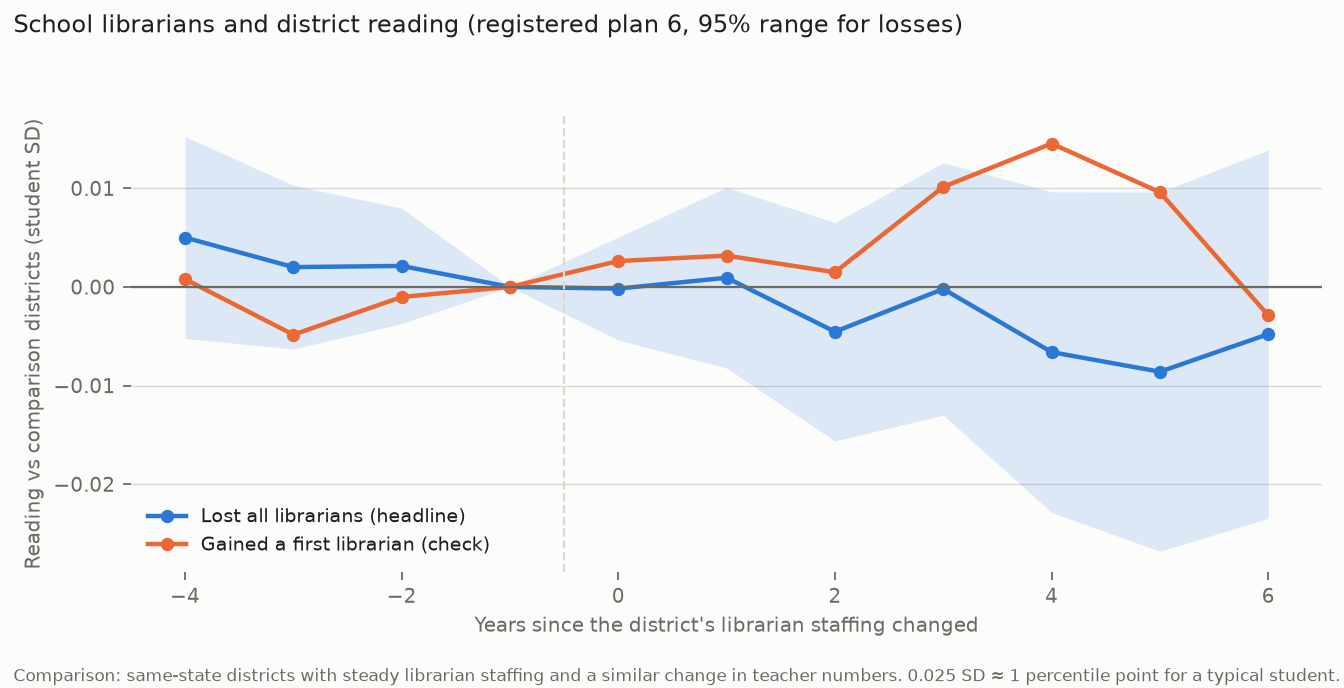
The fourth registered test looked inside the school. Between 2006 and 2019, school librarian positions reported to the federal government fell by about a quarter, and many districts lost theirs in different years. I compared the 1,937 districts that lost all their librarian positions with districts in the same state whose librarian staffing stayed steady and whose teacher numbers changed by a similar amount, so a general budget crisis wouldn't be blamed on the librarian. Reading scores barely moved: a change of about a tenth of a percentile point, ruling out any drop bigger than about half a point. Districts that hired their first librarian leaned slightly the other way, also within the noise. Earlier studies found higher scores in schools with librarians, but compared different schools at one point in time; this before-and-after comparison doesn't show a measurable effect on district test averages.
The honest summary: a small advantage follows new libraries, and it is a little larger right next to them, but every test of access says it isn't about being closer to books. Losing a school's librarians didn't measurably move district reading either. It doesn't follow walking or driving time, district-wide or school by school; it isn't specific to reading; and it continues a rise that started before the doors opened. The likeliest explanation is where libraries get built: in parts of a district that are already growing or improving. That doesn't mean libraries don't matter for reading; it means comparing places that got libraries with places that didn't can't show it. A cleaner test would use openings whose timing was set by something unrelated to local growth. I piloted one with library building votes that narrowly passed or failed: narrow passes do get built, but mostly as expansions of existing libraries rather than new branches, and there are too few close votes to test reading scores.
Where the evidence comes from matters too. Each test learns only from the places that changed: districts or schools that got a new library nearby, or lost their librarians. Comparison places cover nearly the whole country, but new libraries were built unevenly: California and Texas alone supply almost a third of the districts near new libraries. So the library results say most about fast-growing places like those, and least about the rural South and the Mountain West, where few new branches were built.
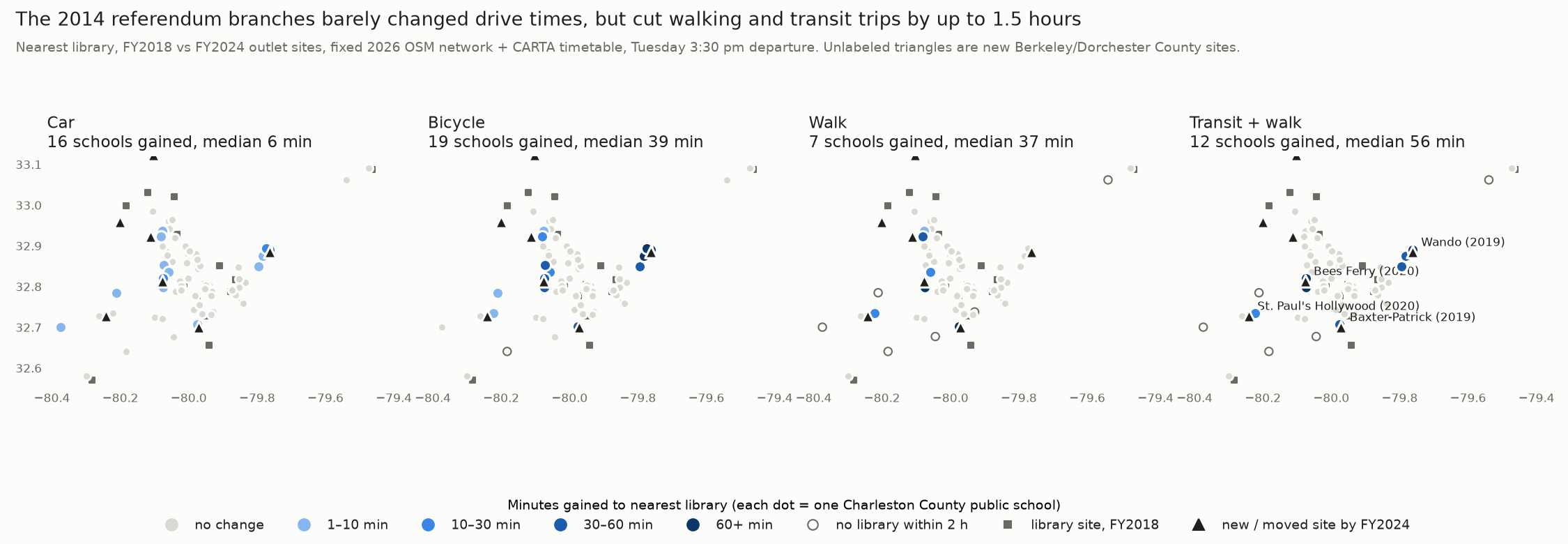
Try it yourself: How Far Is the Library? An interactive map of Charleston County schools where you can switch between car, bike, walking and bus, and add the new branches.
Tools: Python, pandas, GeoPandas, r5py (network routing), OpenStreetMap, Census geocoder, state school test files (Texas, California), federal school discipline data (CRDC), school staffing data (NCES CCD), staggered difference-in-differences, cluster bootstrap inference, HonestDiD sensitivity analysis, pre-registration (OSF)
Code, data pipeline and the registered plan will be public with the working paper.