An Asteroid’s Shape, Recovered From Brightness Alone
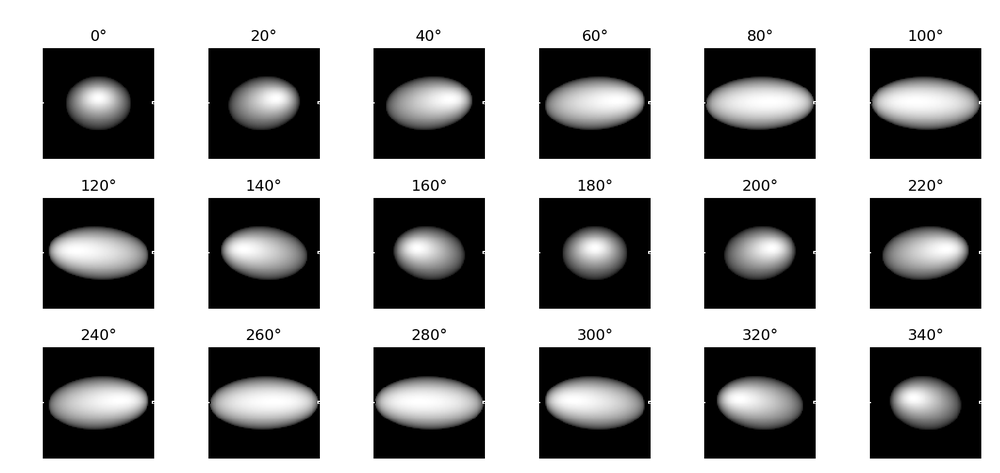
The question
No ground-based telescope can resolve most asteroids into more than a point of light. Yet the way that point brightens and dims over months encodes the body's proportions and the direction its spin axis points. How much shape can be recovered from brightness alone?
The approach
Silhouette inverts amplitude-versus-viewing-geometry relations analytically. As an asteroid moves along its orbit we view it from changing angles, and the changing light-curve amplitude constrains the axis ratios and the spin pole. A chi-squared map over every possible pole direction makes the solution, and its degeneracies, explicit instead of hidden.
The result
For asteroid (15) Eunomia, 22 light-curve amplitudes suffice to pin the axis ratios at 1.68 : 1.00 : 0.81 with a well-localized spin pole and a fit quality of reduced chi-squared 1.15.
Tools: Python, NumPy, SciPy, analytic inversion with grid search
Read the code: Silhouette on GitHub →