From Raw Telescope Pixels to Numbers You Can Trust
The question
A telescope image is just pixels: noise, stars, cosmic rays, and somewhere in there, the target. Turning that into a measurement with an honest error bar is most of the daily work of observational astronomy, and doing it by hand does not scale.
The approach
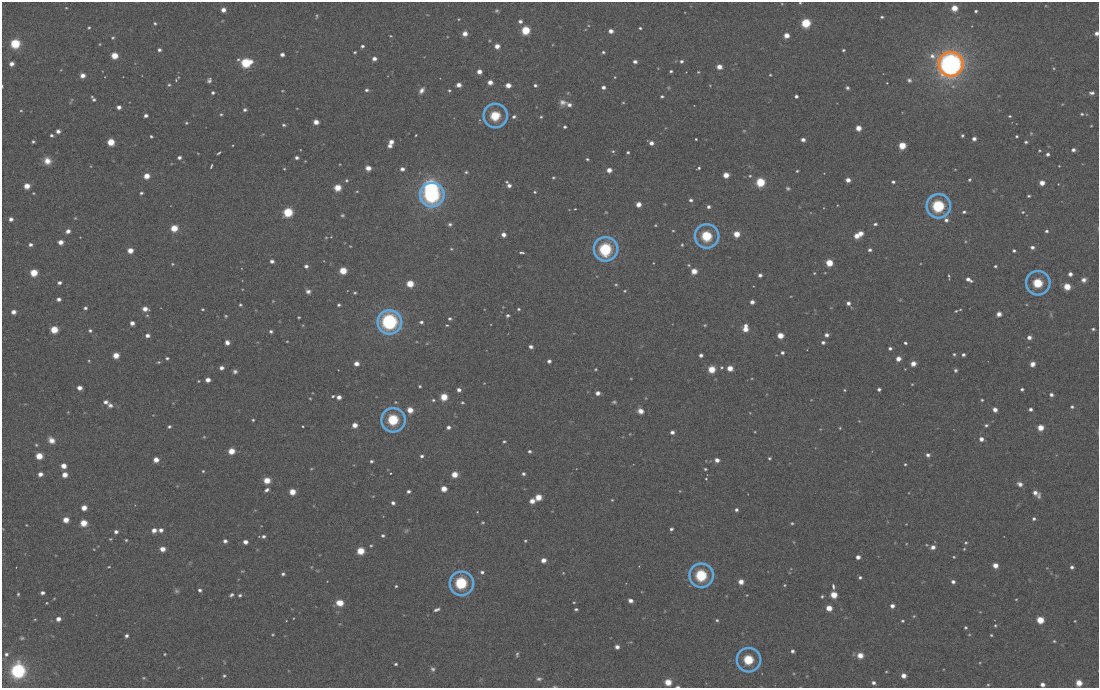
Squint automates the full chain: background estimation, source detection, point-spread-function fitting, astrometric solutions, and photometric calibration against the APASS and SDSS star catalogs, with systematic errors estimated from the calibration stars themselves rather than assumed.
The result
Raw FITS frames from Las Cumbres Observatory’s robotic telescopes become calibrated magnitudes with per-point uncertainties, reproducibly and unattended, feeding directly into downstream analysis tools such as SpinDoc.
Tools: Python, astropy, PSF photometry, APASS/SDSS calibration
Read the code: Squint on GitHub →