One Rock or Two? Letting Physical Models Compete
The question
Asteroid (216) Kleopatra's brightness swings by nearly a full magnitude every 5.4-hour rotation. A single elongated body could do that. So could two bodies orbiting in contact. The light curve looks ambiguous to the eye; is it?
The approach
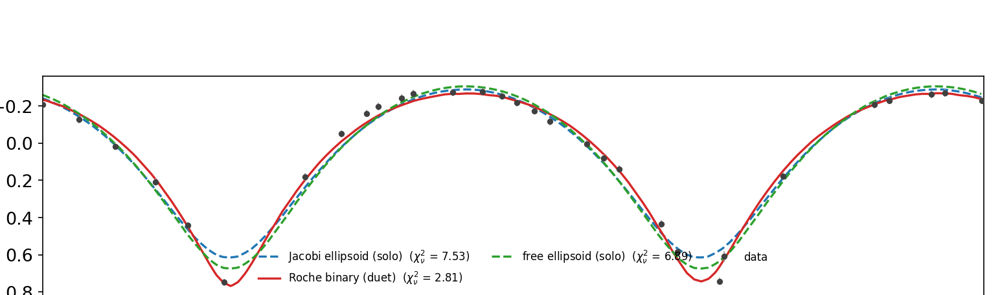
SoloDuet fits three physically motivated models to the same light curve, following Lacerda & Jewitt (2007): a fluid-equilibrium Jacobi ellipsoid, a free triaxial ellipsoid, and a Roche contact binary. The comparison is scored with goodness-of-fit and information criteria rather than eyeballing, and the fit returns physical parameters, not just curves.
The result
The contact-binary model wins decisively on this data (reduced chi-squared of 2.8 against 6.9 and 7.5 for the single-body alternatives), returning a mass ratio near 0.9 and a bulk-density estimate. Radar imaging independently shows Kleopatra to be a two-lobed body, exactly what the photometry-only verdict said it should be.
Tools: Python, NumPy, SciPy, chi-squared and BIC model comparison
Read the code: SoloDuet on GitHub →